
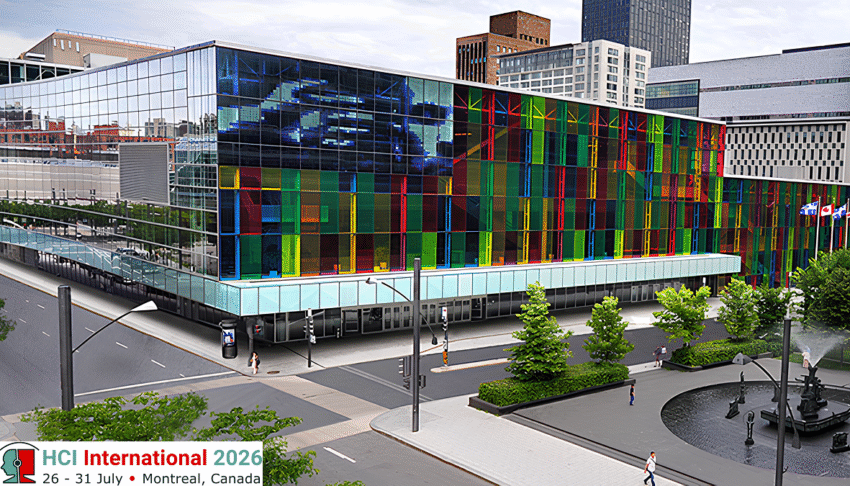

At this year’s HCI International conference in Montreal, Canada, we run a parallel session on the topic Enabling Technologies for Neurodiversity at Work.
Dates: 26th – 31st July 2026
Location: Montreal Convention Centre, Montreal, Canada
Conference Website: https://2026.hci.international/duxu
We are pleased to announce the authors who had their work accepted for this session:
- Beyond labels: realism and participatory design as keys to effective AI-Based neurodiversity training in the workplace
Valentina Olivieri, Beatriz Lopez, Stephen Kapp (University of Portsmouth, UK) - Evaluating the IMAGE Employability Toolkit for autistic university graduates through an HCI Lens
Marc Fabri (Leeds Beckett University, UK) and Priscila Beni (Universidade Federal do Rio Grande do Sul, BR) - Technology: The Door to a World I Wouldn’t Otherwise Access
Angela Taylor (University of Manitoba, CA) - Enabling Neurodiversity at Work: A Case Study of Inclusive Lab Cultures and Enabling Technologies
Noah Glaser (University of Missouri, US), Nigel Newbutt (University of Florida, US), Chele Dugger (University of Missouri, US), Marisa Chrysochoou (University of Missouri, US) - From Theory to Practice: Embedding the Double Empathy Problem in AI-Supported Virtual Environments
Nigel Newbutt (University of Florida, US), Timothy Vogus, Miroslava Migovich, Daniela Alexandra Castano Lavado, David Caudel, Zalen Ingram, Keivan Stassun, Nilanjan Sarkar (all Vanderbilt University, US)
We are really looking forward to welcoming the presenters and many others at the conference.
Session Overview
This session explores how Human–Computer Interaction (HCI) research and design can advance neurodiversity inclusion in the workplace through innovative and enabling technologies. As more organisations seek to create equitable and inclusive work environments, there is a growing need for evidence-based approaches that empower neurodivergent individuals, including those who identify as autistic, dyslexic, ADHD, dyspraxic, or otherwise neurodivergent. This covers all stages of the employment lifecycle: preparation, recruitment, participation, progression, and leadership.
The session aims to bridge research and practice, showcasing innovations that demonstrate measurable impact and inclusive design excellence. Contributions are expected to reflect evidence-based best practices, propose new research frameworks, or present co-created technological solutions that enable neurodivergent people to thrive in professional environments. Together, these contributions will advance a shared HCI-informed research agenda for equitable, sustainable, and human-centred neurodiversity employment futures.
Read the original Call for Papers.
Marc Fabri, Leeds Beckett University
Nigel Newbutt, University of Florida
Attending the conference
This parallel session is held as part of DUXU: The 15th International Conference on Design, User Experience and Usability (https://2026.hci.international/duxu). The parallel session will be scheduled either on the 29th, the 30th or the 31st of July 2026. To register for the conference, please visit https://2026.hci.international/registration.html.
Journal paper opportunity
 If your research is in the area of Neurodiversity for Work, you will be interested in call for papers on on this topic, for a special issue to appear in the Journal of Enabling Technologies. Submissions will undergo a double-blind review process. The call and a detailed timeline for special issue submissions and publication will be confirmed soon – watch this space!
The Journal of Enabling Technologies provides an international and multi-disciplinary evidence-base in health, social care, education and design on how technologies can enable disadvantaged, disabled, or otherwise marginalised groups to live full and happy lives. It has a Scopus CiteScore of 4.0 and a 5-year Impact Factor of 1.5.